
From Westmeath to War: The Life of Edward Scally

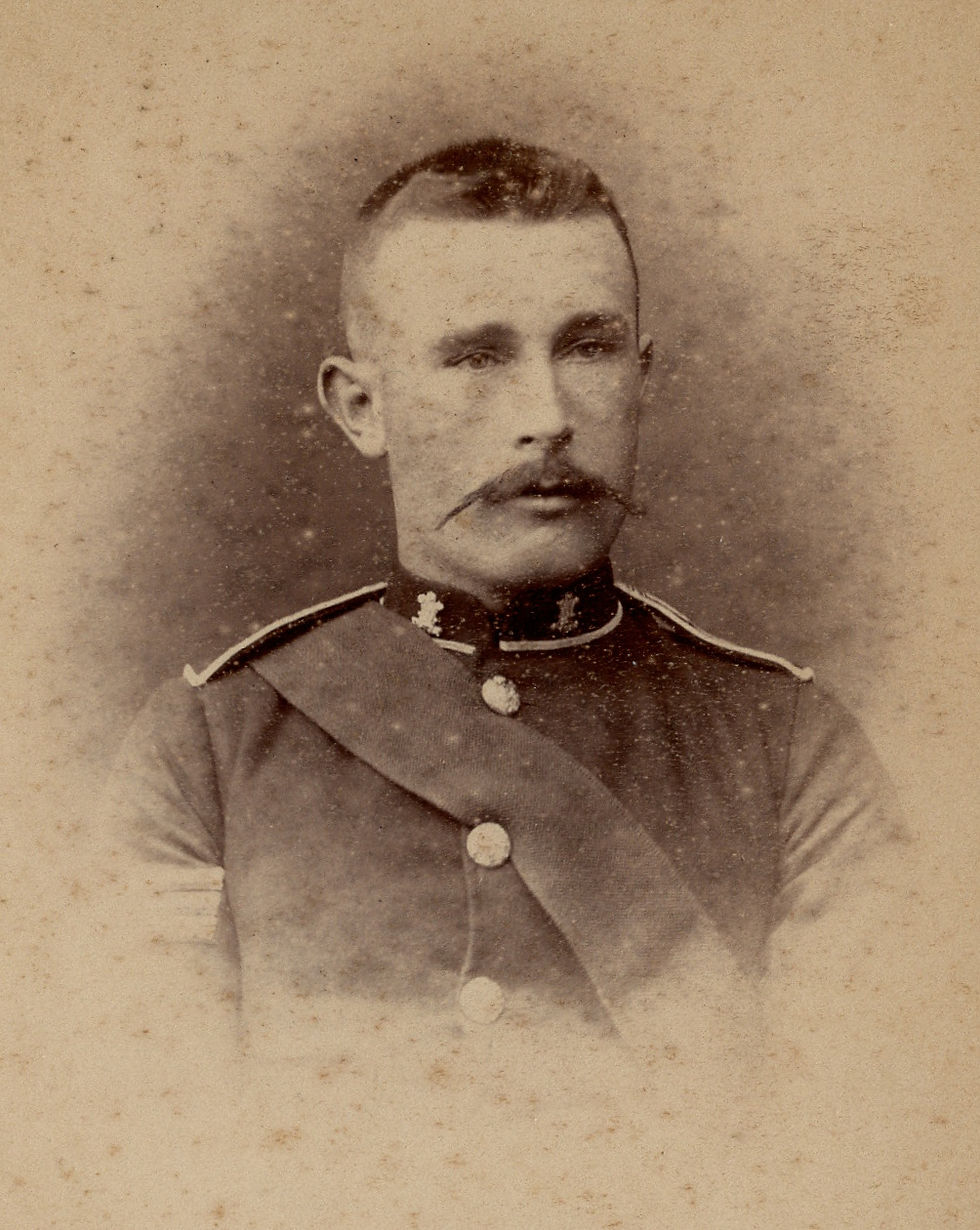
Sometimes, when researching the man behind the uniform, the first reaction is disappointment when no service papers survive, as they are often the catalyst for deeper investigation. Yet in many cases, where those records are lost, a soldier’s life can still be reconstructed from other sources. In the case of Edward Scally, the surviving evidence reveals a man who served in two wars, worked for Guinness, and carried unseen scars that ultimately became too much to bear. This is his story.
Edward Scally was born on 22 October 1872 in Rathduff, County Westmeath, near the village of Ballynacargy. He was the son of Thomas Scally and Bridget Scally (née Larkin). Thomas was a labourer.
As no service papers survive for Edward, we can piece together some details of his military career via his army service number of 4171, which would place the date of enlistment in the Leinster Regiment around the end of 1893. With the outbreak of the Second Anglo‑Boer War, he went to South Africa with the 1st Battalion, Leinster Regiment. For his service in the conflict he received the Queen’s South Africa Medal with the clasps “Cape Colony”, “Transvaal” and “Wittebergen”, and the King’s South Africa Medal with the clasps “South Africa 1901” and “South Africa 1902”.
After Edward left the army, he took up employment in Guinness’s as a Special Policeman on 11 January 1904, which would remain his employer.
Edward married Mary Molyneux in the Roman Catholic Church at Saggart, County Dublin, on 6 September 1906. Edward’s address was listed as Grove Avenue, Rathmines, and Mary’s was given as Hazelhatch. Mary’s father was listed as George Molyneux.
Their daughter Myra was born at Newcastle, County Dublin, on 4 July 1904. Edward’s address was listed as 16 Grove Avenue, and his profession as a policeman. Sadly, Myra died on 28 April 1905 as a result of enteritis, which lasted six days. Edward was listed as a watchman in a brewery. Another daughter, also named Myra, was born at No. 99 Harold’s Cross on 20 August 1905. The family is recorded on the 1911 census as living at No. 13 Drummond Place, Dublin. Edward is listed as a policeman in the Guinness brewery.
With the outbreak of the Great War, Edward enlisted back into his old regiment on 3 September 1914, gaining the rank of Sergeant. Guinness employees were encouraged to join the British Army, with some 800 employees joining. While on service, half their wages would be paid to them, and their job was guaranteed back after the war.
Edward’s low service number suggests he originally joined the 6th (Service) Battalion, which had only formed in August, before being transferred to the 2nd Battalion. Edward went to France on 27 April 1915. He was reported as wounded in the Morning Post on 4 August 1915. Following his injury is likely when Edward transferred into the Labour Corps, where he remained until his discharge on 7 December 1917.
Edward rejoined Guinness’s in December 1917 and would remain working there. He received the Silver War Badge on 18 January 1918, which was intended to be worn in civilian life to show he had served and had been either wounded or become ill. He also received the 1914–15 Star, British War Medal and Victory Medal for his war service.
In the ten or so years after leaving the army we don’t know much of what Edward’s life was like, and for whatever reason, he decided to take his own life in November 1928. His death was reported in The Irish Times on 21 November 1928:
“MAN’S BODY FOUND AT DOLLYMOUNT
INQUEST TO BE HELD TO-DAY
Yesterday afternoon the body of a man was found at the Bull Wall, Dollymount, on the rocks facing the Royal Dublin Golf Club. Papers found in the clothes gave the name of Edward Scally, 15 Armstrong place, Harold’s Cross, Dublin.
Sergeant O’Reilly and Guards Shevlin and Geraghty had the remains removed to the licensed premises of Mr. O’Dwyer, Raheny, where an inquest will be held this morning.
The man was dressed in a navy blue suit, and papers found in the pockets indicated that he was an ex-soldier, and, apparently, had been an employé of Messrs. A. Guinness Son and Company. A photograph of himself in the uniform of the Irish Guards, and photographs of a women and young girl, ap-parently his wife and daughter, and a penny, also were found in his pockets.”
Edward’s death certificate records that he was found on 20 November 1928, and ruled the cause of death as “Asphyxia through immersion in the River Liffey, self committed whilst suffering from temporary insanity (Post Mortem).”
Edward’s wife, Mary remained in their home, No. 15 Armstrong Place, Dublin, and died on 24 February 1939, as a result of heart failure. Myra was present at her death. Myra later moved to England, became a school teacher, never married and died on 30 September 1990.
Edward Scally’s life, recovered from scattered records, stands as a reminder of the many ordinary men whose service and struggles were rarely recorded in full.



Comments