
From Malta to Salford: The Story of Thomas Carroll


During a trip to Malta in 2025, the temptation to visit a few graveyards could not be resisted. One morning, leaving early, I set out for Ta’ Braxia Cemetery. Established in October 1857 and lying not far from Valletta, it contains countless British military burials.
After some time wandering around, I found what I had been looking for: a memorial to the men of the 100th Regiment who died during the cholera outbreak of 1865. The 100th Regiment of Foot was the antecedent of the 1st Battalion, Leinster Regiment, so it was of particular interest to me. The memorial had originally stood near the bastion cemetery at Floriana before being moved to its present location.
Seeing it prompted me to look again at an item in my own collection, a wooden walking stick with an ornate engraved metal handle bearing the inscription: “No 4145 / T CARROLL / LEINSTER REGT”.

The stick belonged to Thomas Carroll, who was born in Malta in 1864. He was the son of John and Johanna Carroll (née Lynch). John, a Limerick man, had joined the 100th Regiment of Foot in Canada on 23 April 1858, having married Johanna in Quebec the previous year on 21 July 1857.
The 100th Foot left Malta in 1866 and remained stationed in Canada until November 1868.
Thomas followed his father into the regiment, joining the 100th Foot on 10 November 1879 as a boy soldier at Sialkot (now in Pakistan, then part of British India). He was sixteen years old, recorded as 5 feet 2¾ inches tall, with hazel eyes and dark brown hair.
He served with the 1st Battalion in India until 13 January 1895. During this period he sat for a portrait photograph along with all the battalion’s sergeants. After returning home, he completed a further two years of service with the 5th (Militia) Battalion. During this time he married Ellen Smith at St Joseph’s Church, Salford, on 9 July 1895. He was discharged from the army on 10 January 1898, after 18 years of service.
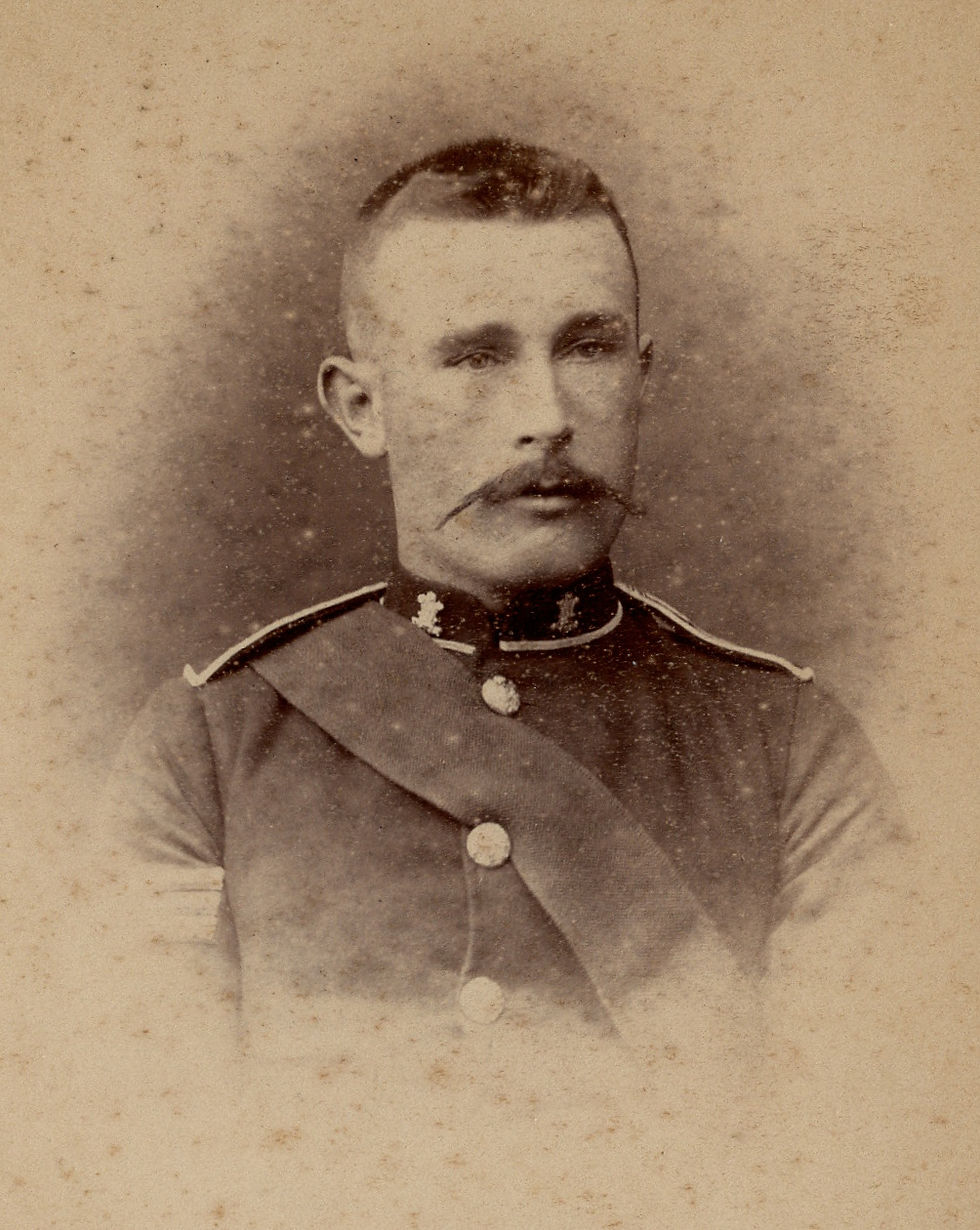
The 1901 census records Thomas, Ellen, and their children Herbert (4) and Florence (2) living at 6 West Elizabeth Street, Salford. By 1911 they had moved to 14 Sarah Street. Florence is no longer listed, and two more children, Edith and Thomas, had been born. Thomas (senior) is described as an army pensioner and corporation labourer.
During the Great War, a fifty‑year‑old Thomas enlisted in the Manchester Regiment on 13 April 1915. A year later he transferred to the Royal Defence Corps, a unit which provided internal security and home defence for the United Kingdom. Thomas served entirely at home until his discharge on 12 April 1919.
The 1921 census places Thomas, Ellen, and their children Thomas and Edith at 2 Charlotte Street, Salford, with Thomas working as a general labourer for Salford Corporation.
He remained in the Salford area for the rest of his life, dying there in 1936. Interestingly, he earned no medals during his service, not even for long service, making his walking stick a personal reminder of his 22 years in the army.


Comments