
Boer War Brothers - the McTiernans

Introduction

Historical research often throws up small, interesting pieces of information, which at the time of discovery, might have no immediate use. While compiling the names of soldiers for Birr Military Cemetery, an intriguing newspaper article gave a detailed account of the military funeral of Sergeant Patrick McTiernan of the Leinster Regiment, who was buried in Clonoghill Cemetery, Birr in 1903. While the information didn’t belong in the book, it was interesting enough to set aside for later.
A few years later, a Queen’s South Africa medal for the Second Anglo Boer War appeared for sale at auction. The medal was named to Private James McTiernan of the Leinster Regiment. While not the McTiernan that was the subject of the previously mentioned newspaper article, it was in fact his brother, and he had died during the war in South Africa. That was enough to justify digging deeper into the story of these brothers. What follows is the result.
James McTiernan
James McTiernan was born in Banagher, King’s County around 1866. He was the son of Sub-Constable Thomas McTiernan and Mary McTiernan (née Murtagh). Thomas was a serving member of the Royal Irish Constabulary from the mid-1860s onwards, with the majority of his career spent in the town of Banagher, King’s County (Offaly). Thomas was probably regarded as part of the local community, and he is even recorded as donating money towards a town clock. He had several children with Mary, all of whom were born in the town or Shannon Harbour. Thomas retired on 20 January 1880 and he died in Banagher on 12 July 1891, from bronchitis.
James’ early life is largely undocumented. He was committed to Kilmainham Gaol on 23 June 1890 for the embezzlement of £5. He was recorded as being a goods clerk and living in Sallins, County Kildare. Physically he was described as being 5 foot 9 inches tall and having brown eyes and black hair. He served two months in prison and was released on 22 August. This appears as his only encounter with the law.
The following year, on 15 June 1891 he enlisted for service in the 1st Battalion, Leinster Regiment at Birr. His service papers do not survive, which begs the question whether he answered the enlistment question - “Have you ever been sentenced to Imprisonment by the Civil Power?” truthfully.
Service with the battalion would have taken Private McTiernan to India and Canada. With the outbreak of the Second Anglo Boer War in October 1899, the battalion sailed from Halifax, Canada, to South Africa, arriving in early May 1900.
On 22 November 1900, the Daily Express recorded Private McTiernan as having died from rheumatic fever on 17 November. On the same date The Midland Counties Advertiser had reported McTiernan as dangerously ill at Standerton. Other records show that James died at Vrede - a small town in the Free State. James’ cause of death from rheumatic fever was probably exacerbated by the conditions of serving in South Africa and the limited ability to treat the condition probably led to rheumatic heart disease. His death was typical for men of the campaign in South Africa, death from disease rather than combat with the enemy.
Private McTiernan was buried in Vrede Military Cemetery and his name is commemorated on the 1st Battalion, Leinster Regiment Boer War memorial in St Patrick’s Cathedral, Dublin.
On 25 June 1908, The Midland Counties Advertiser reported the unveiling of a Leinster Regiment memorial in Vrede:
“Leinster Regimental Memorial
Our acknowledgements are gratefully given to the editor of that appropriately named journal, “The Regiment,” for permitting us to present the picture of the monument recently erected by their sorrowing comrades over the graves of the 1st Leinster officers and men who lost their lives while on active service in the Orange River Colony. To hear that members of the South African Constabulary reverently fringed the tombstone with wreaths as seen in the picture, must be a source of sweet satisfaction to the bereaved relatives; and all the more so when it is known that the time selected was last St. Patrick’s Day, 1908. The names not being sufficiently visible in the photograph, we append the whole inscription exactly as the lettering appears on the tablet, viz:-
SACRED TO THE MEMORY
OF
MAJOR A. F. C. FOULERTON,
Lieut. J. F. SCOBELL Sec. Lt. F. H. FINLAY
Lce.-Sgt. FARRELL Pte. J. KELLY
Pte. J. MANNING ,, J. MCTIERNAN
,, W. BERGIN ,, J. FARRELL
,, F. FITZGERALD ,, P. GALLAGHER
,, P. LEVENS ,, J. LOWRY
,, D. DARLING ,, W. LYNCH
,, C. WEBB ,, N. MCGIBNEY
,, G. CHEEVERS ,, T. KAVANAGH
,, W. NOLAN ,, J. MONAGHAN
,, T. ABBERTON ,, P. BRADY
,, M. SLAMMON ,, R. KERRIGAN
Who lost their lives at Vrede while serving
In the 1st Batt. Prince of Wales Leinster
Regiment during the South African War,
1900-2.”
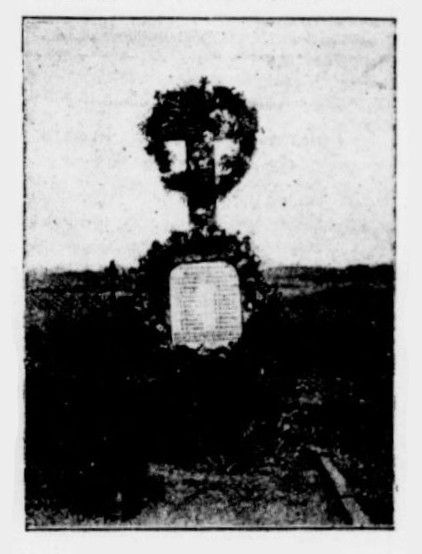
This memorial has not been traced today, and it has possibly been later replaced with the current memorial in the cemetery which records all the British casualties buried in the cemetery.
For his service in the Boer War, Private McTiernan was entitled to the Queen’s South Africa medal with the clasps “Wittebergen”, “Cape Colony” and “Transvaal”.
Patrick McTiernan
Patrick, the older brother, was born in Shannon Bridge around 1861. Like James, little is known about his early life.
Patrick joined the 109 Regiment of Foot on 4 September 1879 at Parsonstown (Birr). He had prior service in the militia with the King’s County Rifles. Upon enlisting he was recorded as being 5 foot, 6 ¾ inches tall, and having grey eyes and brown hair. He was also noted as having a scar on the centre of his back.
Patrick served at home from 4 September 1879 to 21 February 1885, then in India from 22 February 1885 to 13 January 1893, and then home again from 14 January 1893 until 24 February 1898, when he was discharged after 18 years and 174 days’ service, at his own request. During his service he had reached the rank of sergeant and also qualified at musketry at Hyde in 1897.
During his time in the army, Patrick had married Susan Carroll in Birr on 21 January 1883. Susan was a washerwoman who lived in Birr, and was the daughter of a soldier. It’s interesting to note at this time, Patrick’s father Thomas is recorded as a workhouse porter, a hint that his RIC pension was not enough to sustain him and his wife. Patrick and Susan had two children together: Patrick Sarsfield, born in India on 25 February 1895 and later baptised at St Joseph Church, Colaba, Bombay, on 25 March 1895; and Maria Evelyn born in Tipperary Barracks on 19 February 1897.
After being discharged from the army, the family lived on Townsend Street, Birr. On 17 June 1898, Patrick re-joined the Leinster Regiment, joining the 3rd (Militia) Battalion, as permanent staff.
With the outbreak of the Second Anglo Boer War, the 3rd (Militia) Battalion, Leinster Regiment were embodied for service on 18 January 1900 and subsequently volunteered for active service in South Africa. They returned home to Birr on 26 May 1902, after two long years in South Africa. Service during the war entitled Sergeant McTiernan to the Queen’s South Africa medal with the clasps “Cape Colony”, “Orange Free State” and “Transvaal”, along with the King’s South Africa medal with the clasps “South Africa 1901” and “South Africa 1902”.
While away in South Africa, Susan, Patrick and Maria were recorded on the 1901 census as living at number 4, Melsop Street, Birr.
Sergeant McTiernan died in Birr Barracks on 5 February 1903, as a result of dysentery and cirrhosis. His wife was present at his death. He was interred in Clonoghill Cemetery on 6 February, with his funeral being reported in The Leinster Reporter on 14 February 1903:
“MILITARY FUNERAL IN BIRR
On Friday, Sergeant Patrick McTiernan, 3rd Battalion Leinster Staff, who died on the pre-vious day at the hospital, Birr Barracks, was buried with military honours. In civil life the sable trappings give funerals a dismal show, but a military funeral has something in it of a triumphant tone as if telling that death was con-quered. The cortege, with measured steps, passed to Clonoghill, where the interment took place in accordance with the deceased’s request. First came the firing party of twenty, with arms reversed, and next the Band preceding the hearse with the coffin wrapped in the Union Jack, the staff sergeants forming pall bearers. Behind that the chief mourners, Sapper Thomas, his and John McDonnell, cousin. Then followed a line of cars and sympathising friends, and bringing up the rear, all the available soldiers in charge of Major Reeves, D S O; Lieut. Burnaund, Or. Master Gallehawk and Sergt. Major Palmer. At the graveside the last rites were performed by Rev P Barrett, R C, but for some reason the usual volleys were not fired, nor the last post sounded. The deceased, who leaves a wife and two children, was from Banagher, and served for twelve years with the colours, portion of the time being in India/ After retiring he was for a few months in the postal service, but receiving an appointment on the Militia Staff he rejoined four years ago. On the outbreak of the war he accompanied the battalion to South Africa, where he contracted dysentery, but remained at the front until the regiment retired las May. He was very popular with his comrades who deeply deplore his early demise. A brother of his died while serving in the Transvaal with the 1st Battalion of the Regt.”
Sergeant McTiernan rests in an unmarked grave.

Susan, Patrick and Maria remained in Birr, the 1911 records them as living in 28, Eden Street. Susan never remarried and died on 4 August 1929, and Patrick joined the British Army, serving in the 8th King's Royal Irish Hussars. He died on 10 August 1961 in Yorkshire. More research is needed to establish what happened to Maria.
Thomas McTiernan
Although this piece focuses on the two brothers who served in the Boer War, the third brother, Thomas, also deserves mention.
Thomas was born in Banagher on 17 May 1872. He joined the Royal Engineers at Ennis on 10 May 1892, recorded as a surveyor. He was 5 foot and 7½ inches tall, with blue eyes and brown hair.
He served for 12 years, all at home, and was discharged on 9 May 1904.
He married Agnes O’Shea in Limerick on 18 October 1898. The 1911 census records them living at 27 Harrison Street, Carlisle, Cumberland, where Thomas worked for the Ordnance Survey.
Conclusion
What began as an attempt to understand the lives of two brothers who served in the Boer War expanded into a broader look at an Irish police family in the late nineteenth century. Before their military careers, the McTiernan brothers were all employed in roles above general labour, yet each ultimately chose to join the army, a sign of the stability, security, and opportunities it offered. Their stories also illustrate how disease, rather than battle, remained one of the greatest dangers for soldiers of the era.


Comments