
A Birr Boy Scout's War - Samuel Morrison

Born on 7 March 1897, Samuel George Morrison began life on Crowe Street, Dundalk, the son of William Morrison, a Belfast plumber, and Sarah Jane Jeffery, a dressmaker from Meath. The couple had married in Belfast in 1882, moving south as William’s work took the family across the island.
By 1901, the Morrisons were settled in Birr, King’s County, living at 48 Newbridge Street. Birr, as a major garrison town, had an extraordinary concentration of veterans. Samuel’s neighbours included John Houlihan, who had fought in the Xhosa War and the Indian Mutiny, and John Scully, a veteran of the Zulu Wars. He may even have crossed paths with John Murray, who received the Victoria Cross for the Maori Wars, who also lived on Newbridge Street for a number of years. Samuel grew up surrounded by stories of empire, campaigns, and distant frontiers.
Samuel attended the Model School in Birr, enrolling in the infant school on 24 October 1901. His attendance records show 76 days in 1903, 138 in 1904, 149 in 1905 and 154 in 1906. He was struck off the infant register on 7 July 1906 with a note stating he had transferred to the boys’ school, the next stage within the Model School system, intended to further the education of older boys. He was also an active member of the 2nd Birr Scout Troop, alongside his younger brother Philip. Scouting had only recently been founded by Robert Baden‑Powell, and Birr’s troop was part of the early spread of the movement across Ireland.

The 1911 census shows Samuel living at 1 Castle Street with his father and six siblings. Recorded as a scholar, he was likely still attending the Model School. Sarah Jane is absent from the record, suggesting she may have been away when the census was taken.
In October 1916, the King’s County Chronicle reported that Samuel had transferred from the 3rd (Special Reserve) Battalion, Leinster Regiment to the 6th (Service) Battalion. The article also noted that his younger and older brothers were serving in the Royal Navy.
By the time he joined them, the 6th Leinsters had already endured Gallipoli and were serving in the harsh climate of Salonika. They later fought in Palestine, before sailing to France in May 1918 to join the final months of fighting on the Western Front. For this service, Samuel received the British War Medal and Victory Medal.
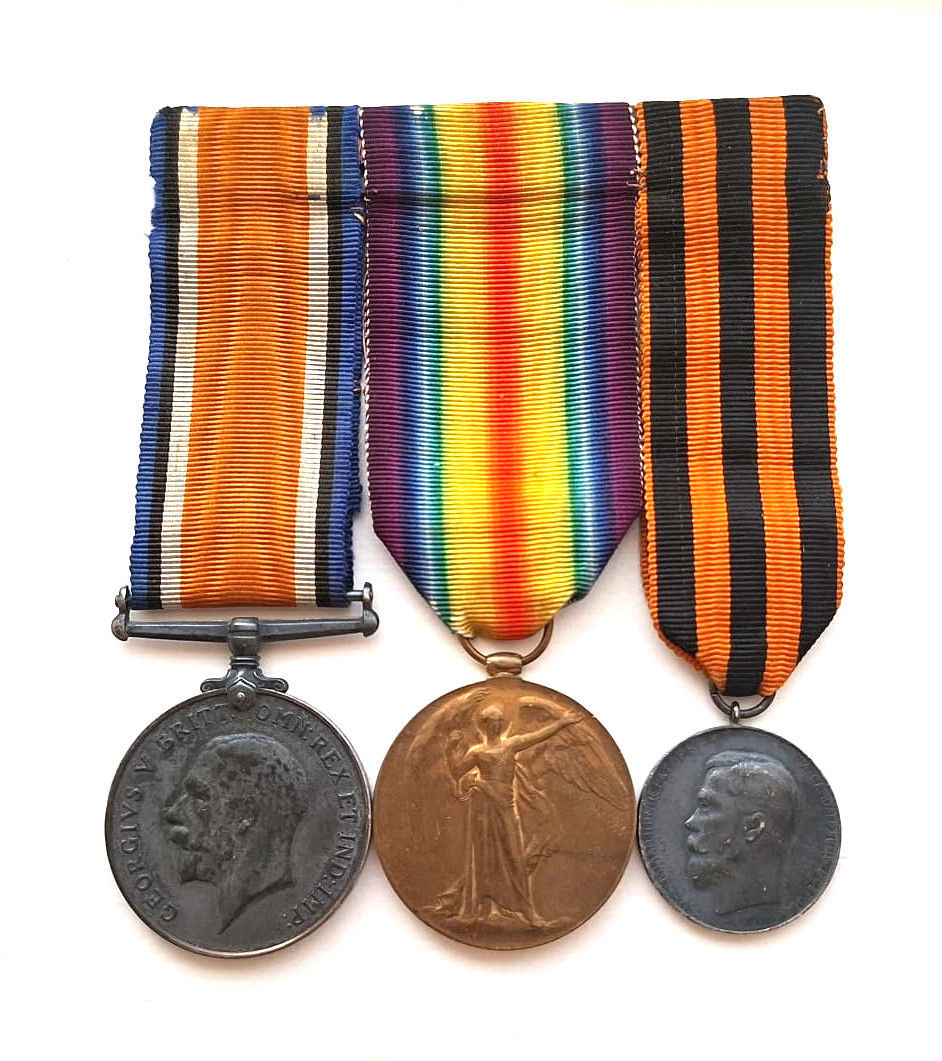
Demobilised in May 1919, he was placed on the “Z” Reserve, a temporary pool of trained men who could be recalled if Germany broke the armistice. As an unemployed veteran, he was offered a place in the newly raised 46th Battalion, Royal Fusiliers, part of the North Russia Relief Force, which was Britain’s final intervention in the Russian Civil War. Conditions were brutal: mud, cold, disease, and confused front lines between Red and White forces. For his actions there, Samuel received an Imperial Russian St George Medal (4th Class).
After Russia, Samuel emigrated to New Zealand, where he married, raised a family, and built a new life far from the streets of Birr and Dundalk. He died in Wellington on 28 June 1975, aged 78.


Another fascinating article.. keep up the good work..Irene and Ossie