
The Centre of Paraguayan Warriors in Recoleta Cemetery

This post takes a slight departure from regular content to explore another continent that has recently captured my interest and imagination.

Recoleta Cemetery is the most well known cemetery in Buenos Aires, Argentina. It contains many imposing memorials to the dead, and while wandering through its passages you might encounter the Centro Guerreros del Paraguay — the Centre of Warriors of Paraguay. This impressive structure was dedicated in 1913, though sources differ slightly on when it was fully completed; it appears the site was inaugurated in 1918, suggesting a multi‑year period of construction. Whatever the exact timeline, the building ultimately served as a meeting and burial place for veterans of the Paraguayan War, also known as the War of the Triple Alliance.
The War of the Triple Alliance (1865–1870) was the bloodiest conflict in the history of South America. It grew out of the Uruguayan Civil War (1864–1865), in which the Blanco and Colorado parties fought for control. Brazil intervened on behalf of the Colorados. Landlocked Paraguay, long isolated and wary of Brazilian expansion and influence over access to the sea, responded by invading Brazil — triggering a wider conflict involving Brazil, Uruguay, and later Argentina. Paraguay declared war on Argentina in 1865, and the three nations formalised their alliance with the Treaty of the Triple Alliance in May of that year.
Paraguay enjoyed some early successes, but its offensives into Brazil and Argentina were halted. Allied forces pushed deep into Paraguay, where the fighting became increasingly brutal. The capital, Asunción, fell in late 1868, yet the war dragged on for another two years until the death of Paraguay’s leader, Francisco Solano López, at Cerro Corá on 1 March 1870.
The consequences for Paraguay were catastrophic. Modern estimates suggest that between 60% and 70% of Paraguay’s male population died during the conflict, leaving the country demographically shattered and financially ruined.
In Argentina, veterans received little meaningful support from the government in the decades following the war. Around November 1891, the Asociación Guerreros del Paraguay (Association of Warriors of Paraguay) was formed to provide assistance to surviving veterans. Many veterans were elderly, disabled, or living in poverty, and the association emerged largely because the state offered no structured system of care, forcing ex combatants to organise themselves to secure recognition, aid, and even basic visibility in public life.
It was not until the 1910s that the Centre for Warriors of Paraguay was constructed in Recoleta Cemetery, serving both as a meeting place and as a mausoleum where veterans could be interred. One of the most notable burials in the Pantheon is Cándido López (1840–1902), the celebrated painter who lost his right arm during the war and learned to paint with his left, whose panoramic battlefield paintings remain some of the most important visual records of the war. His reinterment in the Centre underscored its role not only as a social space for veterans, but as a national site of memory.

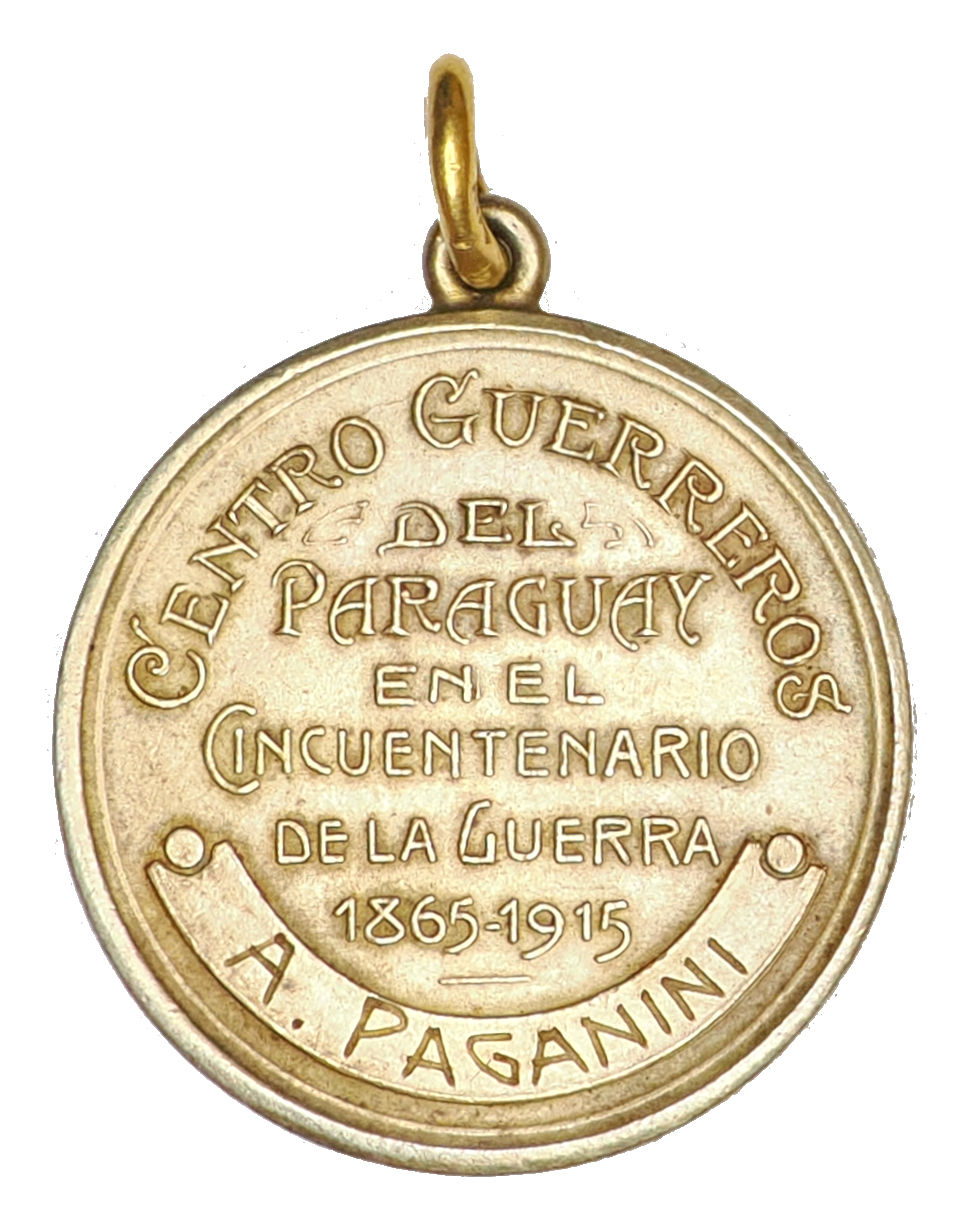
In 1915, at the site (depending on the definitive date of when construction was finished), a commemorative medal was issued to surviving veterans to mark the 50th anniversary of the start of the war. One example of this medal, fortunately acquired in Buenos Aires, bears the name “A. Paganini” on the reverse. Further research revealed this to be Sub‑Lieutenant Antonio Paganini.
Paganini had been in the army since at least October 1866. He was recorded as being in the camp at Guazú Virá, just outside Asunción, on 18 July 1869, while serving with the Legión Militar, a unit largely composed of Italian and French mercenaries recruited in Europe.
The Centro Guerreros del Paraguay stands today as one of Recoleta’s quieter monuments, easy to overlook among grand mausoleums and famous names. Yet within its walls lie men who survived one of the most devastating conflicts in South American history, many of whom fought in the war’s most brutal engagements, such as Tuyutí or Curupayty. The Centre is a reminder of the destruction caused by total war and of the long struggle veterans faced afterwards.


Comments